


I recently saw a LinkedIn post of a founder telling advisors who wanted equity without investing cash to f… off.
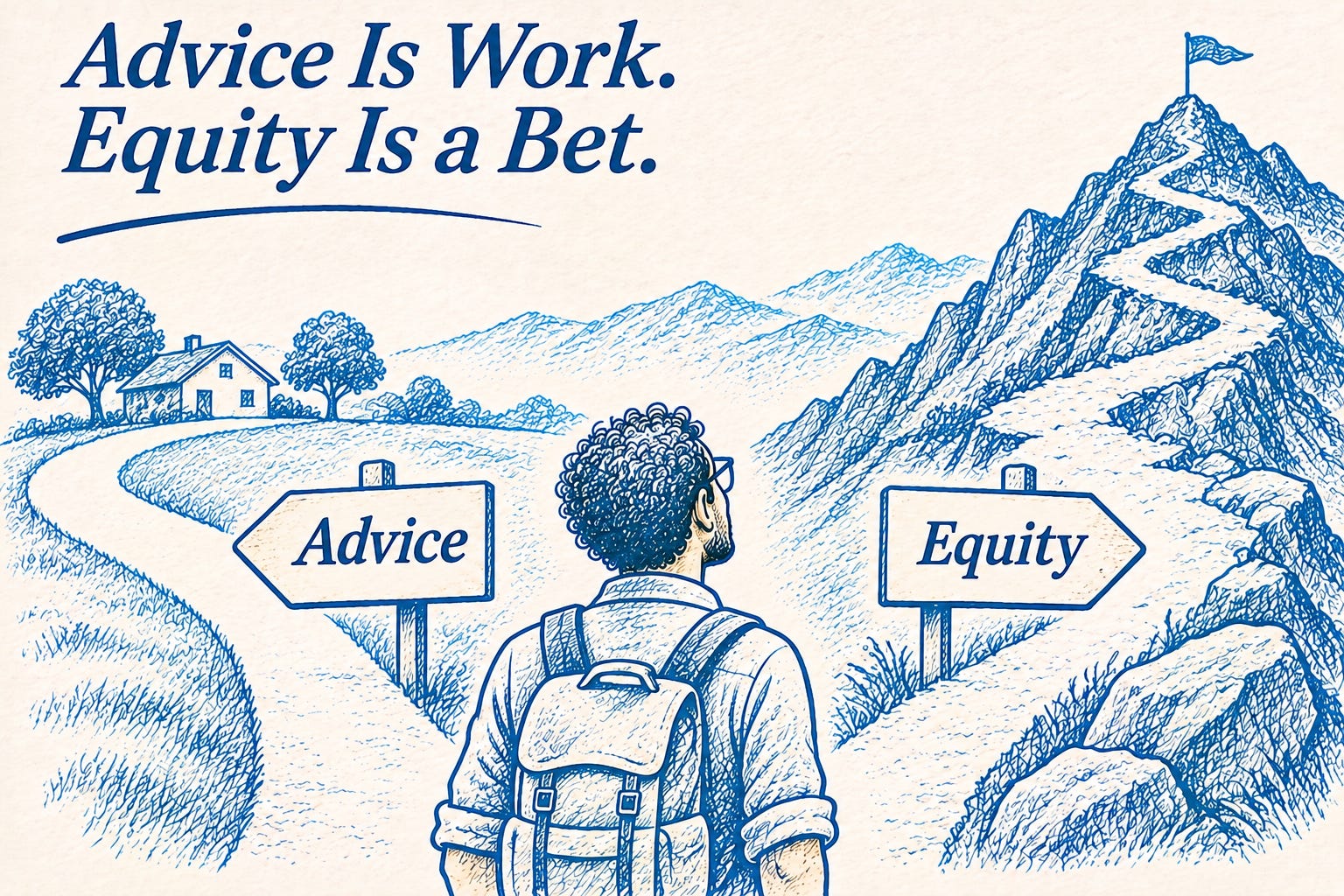
She prices advice at zero unless cash comes with it. I price it with a cash fee, which may be waved for a long term return. Advisors should be careful about investing cash. They should be just as careful about investing their time for equity.
Get paid for your work. And invest – your time or your money – if it matches your portfolio.
As seven time founder, a long-term mentor of Creative Destruction Lab in Toronto and Oxford and as founder of Future Aero Lab, I am an active participant in the Startup world. Yet my view does contradict the current folklore about startup advice.
A recent study by researchers at Wharton and the University of Zurich found that roughly 88% of venture-backed founders receive nothing from an exit. Only on in eight venture backed founders sees money at the end. I saw money from six out of seven of my own businesses. I've invested in about 25 startups over the years and helped more than 30 entrepreneurs build their businesses.
But that doesn't mean I should invest in every company I advise.
Your time and your capital are different assets
You might love a founder and be exactly the right person to help them. That doesn't mean the company belongs in your investment portfolio. You may have enough exposure to the sector you're an expert in. You may get better returns in real estate or the stock market.
I personally enjoy having my daily expenses covered by my operational work. Maybe this is a fallacy, but it helps me sleep better.
Founders assume the experienced advisor has spare cash lying around. Usually he doesn't. Every rich person I know is tight on cash. The house in Mallorca, the real estate portfolio needing refinancing, the PE investments not paying back.
It works the other way too. You may want to invest in a business without being able to help run it. There are tons of attractive ventures I have little qualification for.
You should invest in 100 companies to be a successful angel
If even founders struggle to make money from startups, imagine the odds for business angels. I know many instances where the founder made some money in a medium success, but the angels did not. I had personal exposure to this on both sides. The liquidation preference puts the cap table under water. The founder stays relevant for an exit, the angel from 10 years ago does not. In the end the founder gets a carve-out from the buyer, or a signing bonus in an acqui-hire. The VC fund gets his preference, the common shares of an early angel are worth nothing. Angels only talk about their successes, not about these failures.
Naval Ravikant still has the winning argument: startup returns follow a power law. A handful of extraordinary winners pay for all the failures. In public equities, a concentrated portfolio can work extremely well. In angel investing, concentration is a recipe for disaster.
So the rational thing is to do 100 cheques of €3,000, not 3 of €100,000. But can you really advise 100 startups?
I can't, at least if I want to provide real value for the founders.
So I'd rather have some funds in a good VC fund that has access to companies with momentum than rely on my own network. They get paid to scout the market, I don't.
The reality is: many experienced entrepreneurs and executives invest small amounts in startups simply to stay relevant. It is called pay to play. You put money into a company to be part of the conversation, to have access to interesting founders, or to justify your involvement. As long as you know why you're doing it, great.
Pay to play is not an investment thesis.
Equity for your work is an investment too
What if the startup cannot pay? Many can't. Then your time is the cheque.
You can accept equity as compensation, but recognise that you're effectively financing the startup with your time. Treat that as an investment decision, not as free upside. Ask the same questions you would ask before wiring money. Does it fit your portfolio? How many of these can you afford? And put it in a contract, the way you would with cash.
Even if your work is successful, it can be hard to get the return. Some founders deeply misunderstand the value of advice: for many founders, money invested counts more than years of experience contributed.
For founders
If you’re wondering how to raise your next round, then it may be tempting to get an advisor that comes with a 50k cheque as opposed to a fee. And by all means, convince them to waive their fees for equity if you can. But if they can’t don’t confuse this with a vote against you.
Differentiate between the advice and the money you need.
If you can afford it: The advisor without a stake is the one without a conflict. He can tell you to sell, to slow down, or to say no to the next round. It is hard to give that advice when your own money depends on the answer. The most important investors are those who can fund your investment round. That means they have managed to get capital. But they are very often not your best advisors or board members.
You don't want a board member who is always on the hottest investment for a year but someone who can focus on you. And you may want someone who does not sit on your cap table, but has your personal interest in mind. A good advisor may be more concerned with the founder's own interests, including their health or independence.
The best person for your situation may not want to invest their time or their money. But they may be the one person looking out for your best interests.
Great to see you on Substack. (I opted out again for many reasons....) On the article: Spot on, as always.
You should write a lot more here on Substack! You have so much to share :)
Maybe during the dark months of the year?